
Our Story
Raised with Intention. Guided by Karma.
Karmik Katz is a small, passionate Bengal cattery nestled in Mission, British Columbia — where every kitten is born into a home filled with love, energy, and purpose.

How It Began
A Love That Found Us
Our journey with Bengals didn't begin with a plan — it began with a pull. A quiet, undeniable feeling that something was drawing us toward this breed long before we had the words to explain it. The moment our first Bengal looked into our eyes, we understood. This wasn't chance. This was written.
Karmik Katz was born from that knowing. We believe every soul carries an energy, and that certain animals are destined to find certain people. Our role is not to manufacture that connection — it's to honour it. To raise each kitten with such intention and love that when the right family arrives, the bond is instant, deep, and unshakeable.
Nestled in beautiful Mission, British Columbia, we are a small, home-based cattery where kittens are raised underfoot and surrounded by warmth from their very first breath. Handled daily, socialized with care, and sent into the world ready to love — because that is what they were born to do.
Our Philosophy
Beauty. Energy. Legacy. Attainable.
01
Beauty
We are unapologetic about aesthetics. Every pairing at Karmik Katz is chosen with a trained eye for coat quality, pattern, and that unmistakable Bengal presence — the kind that stops people mid-sentence when your cat walks into the room. Rich rosettes, vivid contrast, glittered coats that catch the light like something wild and rare. We study structure, colour, and expression with the same care a sculptor studies form. We don't settle for ordinary, and neither should you. Beauty in a Bengal is not vanity — it is the outward signature of a lineage chosen with purpose and raised with pride.
The Bengal Breed
What Makes a Bengal Extraordinary
The Bengal is unlike any other domestic cat. Born from careful crossings with the Asian Leopard Cat, they carry the wild in their coat and the warmth of a devoted companion in their heart. Here's what every prospective Bengal owner should know.
Origins & Wild Ancestry
Bengals were developed in the 1960s and 70s by Jean Mill, who crossed domestic cats with the Asian Leopard Cat (Prionailurus bengalensis) — a small, solitary wild cat native to South and Southeast Asia. The goal was never to create a wild pet, but to capture the breathtaking coat of a leopard on a cat with the heart of a companion. Today's Bengals are many generations removed from their wild ancestors and are fully domestic in temperament, carrying only the aesthetic legacy of the jungle — not its nature.
Rosettes, Spots & the Glitter Gene
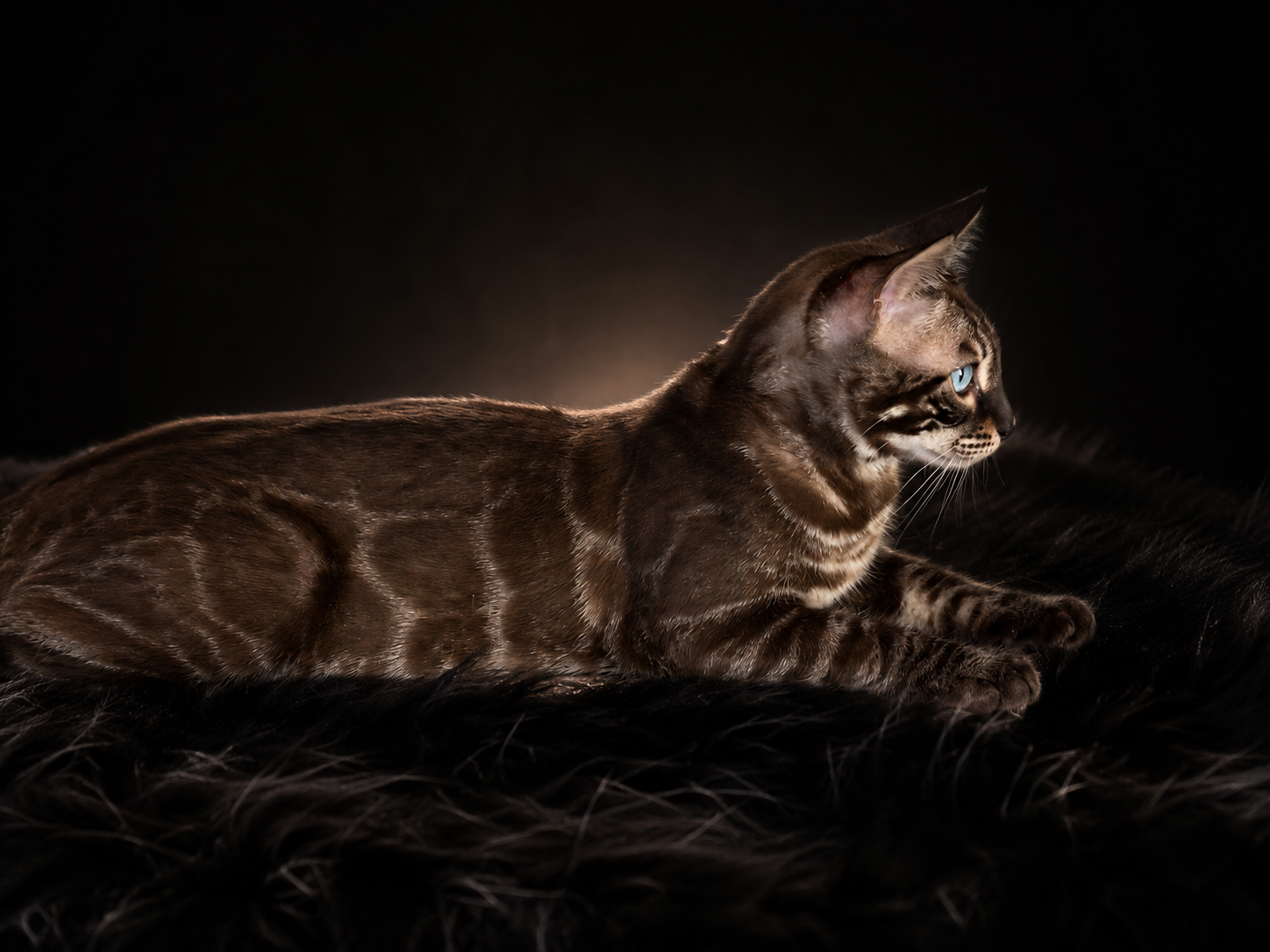
The Bengal coat is one of nature's masterpieces — thick, soft, and pelt-like in texture, lying close to the body in a way that makes it shimmer even without the glitter gene. Patterns range from single spots to complex two-toned rosettes that mirror a jaguar or clouded leopard. Many Bengals carry the glitter gene, a trait unique to the breed that causes each individual hair shaft to catch and refract light, giving the coat an almost metallic sheen in sunlight. It is not a trick of photography — it is simply what they are.
Snow Bengals: How the Gene Entered the Breed
Snow Bengals carry point colouration — the same gene family responsible for the pale coats of Siamese and Burmese cats. This gene was intentionally introduced into Bengal lines in the early days of the breed to create cats with a lighter, more ethereal appearance while retaining the wild rosette pattern. There are three distinct snow variations: Seal Lynx Point (the palest, with blue eyes, carrying the Siamese-derived cs allele), Seal Mink (a warm, creamy tone with aqua eyes, carrying one cs and one cb allele), and Seal Sepia (the richest and darkest of the snows, with gold or green eyes, carrying two cb alleles from Burmese influence). Each snow variation produces a dramatically different look, and understanding which alleles a cat carries is essential to predicting what a pairing will produce.
The Charcoal Gene
Charcoal is one of the most visually striking and least understood traits in the Bengal breed. It is caused by the agouti gene inherited from the Asian Leopard Cat — specifically the Apb (non-agouti Bengal) allele, which interacts differently in Bengals than in other domestic cats. A charcoal Bengal displays a dramatically darkened coat with a bold, dark "cape" across the back and shoulders, a thick facial mask, and a pale, almost ghostly underbelly. The contrast is extreme — far more dramatic than a standard brown Bengal — and the pattern often appears almost graphic in its intensity. Charcoal can appear across multiple base colours, including brown, silver, and snow, each producing a different but equally striking result. At Karmik Katz, we actively breed for charcoal expression because we believe it represents some of the most visually powerful Bengals being produced today.
Blue Bengals
Blue is a dilute colour variation caused by the recessive dilution gene (d/d), which reduces the density of pigment in the coat and produces a soft, cool-toned slate or steel-grey appearance in place of the standard brown. In Bengals, blue is still considered a relatively rare and emerging colour — both parents must carry the dilute gene for blue kittens to be produced, which means many blue Bengals are born to parents who show no blue colouration themselves. The result is a cat with a muted, almost smoky palette that softens the wild pattern into something quietly breathtaking. Blue can also combine with charcoal and snow genetics, producing variations like blue charcoal and blue snow that are extraordinarily rare. We are working toward blue expression in our program and are deeply passionate about where this colour is headed in the breed.
Melanistic Bengals
Melanistic Bengals — sometimes called black Bengals or solid Bengals — carry two copies of the non-agouti gene (a/a), which suppresses the expression of the agouti protein responsible for producing visible pattern. The result is a cat that appears, at first glance, to be entirely black. Look closer — especially in direct sunlight — and the ghost pattern emerges: rosettes and spots still present in the coat, visible as a darker pattern against an already dark background, like a shadow of the wild still written into the fur. This is called ghost spotting, and it is one of the most quietly stunning things a Bengal coat can do. Melanistic Bengals are not a separate colour — they are the same genetic foundation as any other Bengal, simply with the pattern turned down rather than erased. A melanistic cat can carry and pass on all the same colour and pattern genetics as its non-melanistic relatives, which makes them an incredibly valuable part of a thoughtful breeding program. At Karmik Katz, our stud Genesis is a melanistic carrier, and we occasionally produce melanistic kittens as a result of our pairings.
Temperament & Personality
Bengals are highly intelligent, intensely curious, and deeply loyal. They bond with their families in a way that feels less like ownership and more like partnership — following you from room to room, inserting themselves into whatever you are doing, and communicating with a rich vocabulary of chirps, trills, and chatters that most owners quickly learn to interpret. They are not a cat that is content to be admired from a distance. They want to be involved. They want to know what you are doing, why you are doing it, and whether there is any chance it involves them.
Activity & Enrichment
This is an athletic, high-energy breed built for movement. Bengals love to climb, leap, and explore every vertical surface available to them. Tall cat trees, puzzle feeders, exercise wheels, and daily interactive play are not optional — they are essential to a Bengal's wellbeing. Cat exercise wheels are a favourite in Bengal households, allowing your cat to run at full speed indoors and burn off that wild energy constructively. Many Bengals can also be leash trained and taught to fetch, and some take to harness walks with genuine enthusiasm. A bored Bengal is a creative Bengal — and creative Bengals redecorate.
Love of Water & Allergy-Friendliness
Unlike most domestic cats, Bengals are genuinely fascinated by water — a trait believed to trace back to their Asian Leopard Cat ancestry, which is known to hunt near streams and wade readily. Don't be surprised to find yours splashing in the sink, batting at a running tap, or attempting to join you in the shower. A pet fountain is a popular and practical choice for Bengal households. As a bonus, Bengals produce lower levels of the Fel d 1 protein — the primary allergen responsible for cat allergies — than most breeds. While no cat is truly hypoallergenic, many allergy sufferers find they can live comfortably and happily with a Bengal.
Health Testing at Karmik Katz — Wisdom Panel
Every adult cat in our program is tested using Wisdom Panel for Cats — one of the most comprehensive feline genetic health screens available. A single test screens for over 45 genetic health conditions, including Hypertrophic Cardiomyopathy (HCM), Progressive Retinal Atrophy (PRA), Pyruvate Kinase Deficiency (PKD), and a full range of blood type and drug sensitivity markers. It also provides a complete breed composition analysis and screens for physical trait genes including coat colour, pattern, and body type — giving us a detailed genetic picture of each cat before they ever enter a pairing.
Ready to Welcome a Bengal into Your Life?
We'd love to help you find the perfect match. Reach out to learn about upcoming litters or to join our waitlist.